Explore the Advantages of Long-term Two-Wheeler Insurance
By Sagar Narang
Explore the Advantages of Long-term Two-Wheeler Insurance

Homepage  > Articles >

Explore the Advantages of Long-term Two-Wheeler Insurance

Table of Contents

Toggle

Explore the Advantages of Long-term Two-Wheeler Insurance

By Sagar Narang
Explore the Advantages of Long-term Two-Wheeler Insurance

Two-wheelers are such a common mode of transportation these days, that everyone has at least one two-wheelers. And when it’s a vehicle, there’s always this risk of loss due to accidents, thefts, or man-made disasters. It must be obvious from the title of the topic we are going to cover in today’s blog. Yes, it’s about long-term two-wheeler insurance. To give an overview, two-wheeler insurance gives financial protection to insured vehicles from threats like accidents, thefts, or other issues. Plus, third-party bike insurance is made compulsory for all types of two-wheelers, by the government via the Motor Vehicle Act 1988. So here’s everything you need to know about two-wheeler insurance, before getting one. This guide explains everything you need to know about two-wheeler insurance policies in India. Let’s start with defining two-wheeler insurance.

About Long-term Two-Wheeler Insurance

Unlike typical one-year policies, the two-wheeler insurance policy is made to protect your vehicle against unforeseen circumstances for a maximum of five years. Moreover, for a brand-new bike, the insurance plan gives 5 years of coverage, and for old bikes( more than 5 years old), the insurance policy gives coverage of up to 3 years. So, whether it is a minor damage or a huge loss, the long-term bike insurance policy will cover all your claims against third-party liabilities, or any damages to your two-wheeler.

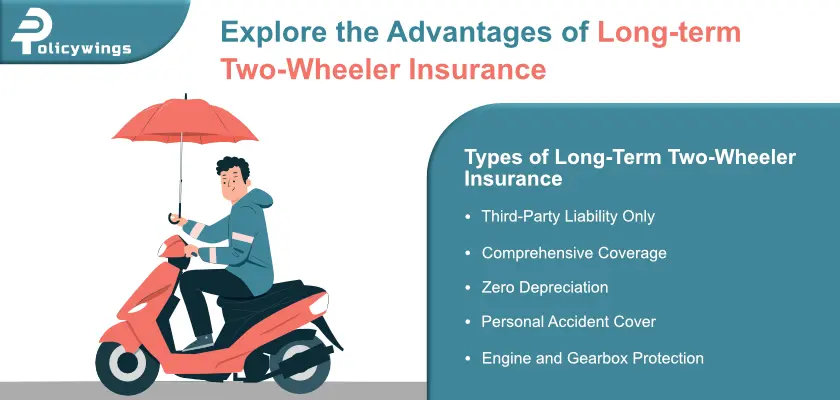
Types of Long-Term Two-Wheeler Insurance

After discussing the basics, let us take a closer look at some important points about two wheeler bike insurance in India. There are two main coverage options available in long-term policies, just like with regular policies:
Third-Party Liability Only: This is mandatory by law, as per the Motor Vehicle Act 1988. This insurance pays for any harm you cause to another person’s car, property, or person in an accident for which you are at fault.
Comprehensive Coverage: This provides more comprehensive protection, covering not only third-party liability but also damage or theft of your two-wheeler. You can further customize your comprehensive policy with add-on covers like:
Zero Depreciation: Protects you from depreciation deductions on your vehicle’s value during claim settlement. 
Personal Accident Cover: Provides financial assistance in case of injury or death due to an accident. Engine and Gearbox Protection: Covers specific repairs to these crucial components.

Comprehensive And Third-party Liability Insurance Comparison

Comprehensive Bike Insurance

Third-party Bike Insurance

Covers losses caused by the bike and third party. It includes any loss due to theft, fire, or man-made disasters. The premium amount is usually on the higher side, as it provides comprehensive coverage. Extends the motor insurance policy with add-on coverage like engine protection, roadside assistance, and zero depreciation.

Covers any loss that occurred due to damage to third-party property. The premium amount is lower compared to the comprehensive one. Provides add-on coverage for personal accidents.

So, you have the option of choosing long-term two-wheeler insurance in both the comprehensive and third-party insurance plans.

Important Features of a Long-term Two-Wheeler Insurance Policy

Some of the important features of a long-term two-wheeler insurance policy are:

  • The policy tenure of three to five years is the most common option.
  • Similar to standard policies, you can choose between third-party liability only (mandatory) and comprehensive coverage (including damage to your vehicle).
  • Policy renewal frequency, once in every 3 or 5 year
  • No premium increases for three years for bike insurance

More Reasons to Buy Long-term Two-Wheeler Insurance?

So, the pros of having long-term two-wheeler insurance are Convenience: No need to hassle with yearly renewals. Potentially Lower Cost: Premiums may be discounted compared to buying one-year policies consecutively. This is so that you are protected from any future premium increases since the premium is set for the duration of the policy. No Claim Bonus Benefits: Compared to typical one-year policies, some insurers offer longer-term policies with better No Claim Bonus (NCB) discounts. NCB is a discount you receive on your premium for every claim-free year. Assured Coverage: Peace of mind knowing your two-wheeler is protected for a longer period.

To Sum Up,

Long-term two-wheeler insurance offers a convenient and potentially cost-effective way to protect your motorcycle or scooter. However, while purchasing two-wheeler insurance, consider your two-wheeler’s value, riding habits, and risk tolerance when selecting coverage. This is because, a brand-new motorcycle might benefit more from comprehensive coverage with add-ons, while an older scooter might be well-served by third parties only in a long-term policy.Nevertheless, if you have more queries regarding two-wheeler insurance, reach out to our team, and they will guide you through all the points.

FAQs

What is long-term two-wheeler insurance?

The two-wheeler insurance is a policy that provides coverage for your motorcycle or scooter for an extended duration, typically spanning multiple years, such as three or five years. It’s very convenient compared to others as it eliminates the need for annual renewals and also allows cost savings compared to renewing annually.

How does long-term two-wheeler insurance differ from regular insurance?

So, the two wheeler bike insurance primarily differs from regular insurance on the basis of the duration of their coverage and the frequency of renewals. So, regular insurance offers coverage for only one year, while long-term insurance offers coverage for multiple years, like three to five years.

What are the benefits of opting for long-term two-wheeler insurance?

Opting for two-wheeler insurance offers benefits like:

  • Convenience
  • Continuous coverage
  • Long-term savings
  • Protection against premium hikes

Can you explain the coverage offered under long-term two-wheeler insurance?

The bike insurance gives coverage for several risks, such as accidental damages, theft, or third-party liabilities, for an extended duration.

How long does a long-term two-wheeler insurance policy last?

A long-term bike insurance policy provides coverage for multiple years, mostly, three to five years.


Share this article:

More on Motor Insurance

Hand-picked reads on motor insurance to help you decide with confidence.

Types of Car Insurance Policies and How to Choose the Right OneCar Insurance

Types of Car Insurance Policies and How to Choose the Right One

Introduction In India, getting insurance for your car is non-negotiable. With so many plans and so many add-ons available, it can be too confusing to choose a car insurance for you. Every option has a purpose. Once you know the types of policies and understand what each one actually covers, making the choice becomes much easier. Whether you’re searching for the cheapest insurance for car or looking for advanced covers, only the right one can help you save money and keep your car truly protected. So, let’s discuss all policy types so that you can pick the one that perfectly fits your needs. Third-Party Car Insurance (Mandatory) This one is the most basic insurance and is also the legally required in India. You just can’t do without it. Even if you are somebody who rarely take out the car on the road, drive rarely, you can’t drive without it. What It Covers: Damages caused to the vehicle of another person Injury or death of a third party Damage to property of the other person What is not Covered: Damage to your own car Theft, fire or natural calamities Personal injuries Who Should Choose It: Car owners who prefer the cheapest insurance for car Those whose old cars have low market value People who drive rarely Note: While it’s certainly affordable it also offers the least protection. Comprehensive Car Insurance This policy is the most popular choice because it gives full protection. Both third-party liabilities as and the damages to you own car are covered in it. What It Covers: Accidents Theft Fire, flood and natural disasters Third-party injuries or damage to property Destruction/ riots Why It’s Worth It: Protects the value of your car Saves the big bill of repair costs Gives peace of mind especially if you are in busy cities This policy becomes lot more practical and powerful by adding covers like bumper to bumper insurance, engine protect etc. Bumper-to-Bumper Insurance Also known as Zero Dep Cover, this is one of the most popular and valuable ones for new or high-end models. What It Offers: Full cost of repair without deducting the depreciation All the metal, plastic, fibre, bumpers and paint are covered Reduces out-of-pocket expenses are cut down a lot Who Should Opt For It: Owners of new cars Owners of luxury car People who live and drive in traffic-heavy cities Anyone who prioritises maximum protection and not just the cheapest insurance for car Standalone Own-Damage (OD) Insurance This is introduced by IRDAI to give car owners a good level of flexibility. What It Covers: If accidental damage happens to your car Damage by fire, flood, riots or vandalism Theft Who Should Choose It: The ones who already have a third-party coverage Car owners who want the freedom to mix and match insurance providers Pay-As-You-Drive Insurance It’s a new and quite a budget-friendly option. Especially for low-usage car owners, it’s really good. Why It’s Popular The premium depends on the total number of kilometres the car has driven If you drive occasionally, you can save money It’s perfect For Owners with two or more cars Users who usually work-from-home Students or retired people Usage-Based / Telematics Insurance In this one, your driving behaviour would decide how much will you pay. How it Works: There’s a device or app that keeps on tracking: Speed Braking Acceleration Driving hours If you drive safely, you will have to pay lower premium. Add-Ons That Transform Your Policy Some ‘extras’ are very useful in enhance your overall protection and fill gaps in basic policies. Most Effective Add-Ons are: Bumper to bumper insurance (zero dep) Engine & gearbox protect Roadside assistance Key replacement Return to invoice Consumables cover These add-ons are worth getting. They make sure that your car insurance protects you from almost all financial shocks that might come your way. How to Choose the Right Car Insurance Policy It really matters to make a wise choice and not just going for the cheapest. Here’s how you can pick what fits your needs the best: Know the Age of Your Car New cars: Comprehensive plus bumper to bumper insurance Older cars: It’s okay to get a basic comprehensive or third-party Set the Right Insured Declared Value (IDV) Too low: You get a smaller claim payout Too high: Premium will be higher Ideally, the chosen value must reflect the true market price of your car. Compare Premium vs. Coverage It’s not always worth to get the cheapest insurance for car. Instead, you must look instead for this: Claim settlement ratio should be high Garage network has to be good enough Add-on options have to be reliable Estimate Your Driving Needs For daily driving in the city: Bumper-to-bumper For occasional use: You need pay-as-you-drive For expert drivers: Basic comprehensive if fine Check Claim Process Simplicity It’s better to choose insurers that offer: Cashless network garages App-based filing of claims Fast settlement process Conclusion When selecting the right car insurance, don’t focus on the cheapest insurance for car. The policy must protect your vehicle as well as your wallet. With different options available like comprehensive plans, pay-as-you-drive, bumper to bumper insurance, etc, the car owners would have no problem finding a the most suitable plan for their needs. The right type and add-ons will ensure that your car stays protected for the coming years. When a policy is well-chosen, it helps save money, reduces stress and also gives peace of mind whenever you are driving. If you feel unsure or need more details, PolicyWings will make it easy for you to compare and make the correct decision.

Written bySagar NarangPublished onDecember 26, 2025

You may also like: Claims & Support

Related guides from our claims & support desk.

WFYP Full Form in Insurance: Meaning, Benefits and How It WorksClaim

WFYP Full Form in Insurance: Meaning, Benefits and How It Works

Introduction Upon buying insurance, you will notice different short forms in your policy documents that might confuse you. One of them is WFYP. It’s very commonly found in papers after the renewal of insurance premium for car or when you check the status of your health insurance premium payment. This short code often confuses people but it’s actually a very simple term to understand. Here, we will explain to you in the simplest way possible so that you know what you are agreeing to when buying a policy or learning your policy status. What Is WFYP Full Form in Insurance? So, WFYP is the short form for “Waiting For Your Premium.” This term in insurance is mainly used by insurance companies when your policy has been generated but the premium amount that you need to pay is still pending. Basically, it means that “Your policy is ready. Once you make the premium payment, we will activate it”. Your policy will not start till you make the payment. Why Does WFYP Matter? It is very important simply because the benefits of your policy will not start until the insurer receives the premium. Don’t just assume that you will be instantly protected after applying for a policy. WFYP clearly indicates that: Your application is accepted Your policy is all set and ready The company is only waiting for your premium so that your coverage can begin You can think of it like ordering food online. It will be prepared but you won’t get it without paying fir it. Why Insurers Use WFYP The real purpose behind using WFYP is used avoid confusion between the issued and an active policy because so many people make this mistake. Insurance companies use WFYP so that: Customers know that their payment is pending No claim is assumed without a premium receipt A record-based transparency is maintained Both parties know when the coverage starts When and Where You Usually See WFYP You can come across the term WFYP commonly during: Purchasing a new policy Renewing a car insurance policy Health insurance premium updates Porting to a new insurer Making changes in policy details Premium payments getting delayed It often shows up on: Policy dashboards SMS alerts Email updates App notifications Documents of proposal/issuance How WFYP Works: Step-by-Step Process Simply put, WFYP is the phase before insurance activation. Here’s how the actual WFYP process works in India: You select a plan: It could be car, health, life or any general insurance Submitting the application: Whether online or through an agent Reviewing your details: The insurer does KYC checks, run medical tests, does vehicle inspection, verifies documents etc. The policy gets approved: Your policy number is generated. Status changes to WFYP: The insurer is now waiting for your premium payment to be made. You pay the premium: Whether through UPI, card, net banking or cash Policy becomes immediately active: Payment is received and now claims are valid. What Happens If You Ignore a WFYP Status? WFYP is a clear message that your policy is not completed yet. You should not ignore it because: You won’t be having insurance protection Claims made will be rejected Your vehicle would be uninsured and this is illegal in India Health benefits don’t start till you make the payment Your policy may be cancelled if the premium is unpaid WFYP in Car Insurance For car owners, WFYP matters more than you think. It directly affects the insurance premium for car and also your legal safety. If your car insurance shows WFYP, it should be cleared immediately because otherwise: You can’t claim for any accidents or damages Third-party liability coverage won’t be active There may be fines if caught without active insurance If it’s a new car, the dealer may not release it without premium confirmation WFYP in Health Insurance Health insurance only works after the premium is paid. Thus, the health insurance premium must be cleared on time. If your policy shows WFYP, it means: Hospitalisation is not covered Cashless treatment is not allowed Waiting periods are not started Benefits for pre-existing disease are not active If overdue, renewal continuity can break Key Benefits of WFYP for Policyholders WFYP is not to be scared of; it’s actually helpful for the customers in many ways: Clear communication: With clear updates, you can instantly know where your policy stands. Prevents misunderstanding: There are no assumptions. You would know when the coverage starts and whether you are insured or not. Helps avoid claim disputes: All the details are clear before the policy gets active. Works as a reminder: Helps with timely premium payment so your policy doesn’t lapse. Tracks policy progress: You can know your policy is at which stage and can also be tracked step-by-step. How to Quickly Clear WFYP Just with a few minutes of attention, you can ensure uninterrupted protection. This is what you should do to avoid delays: Clear the premium payment immediately after the policy is approved Turn on updates (SMS/Email/WhatsApp) from your insurance company Enable auto-debit for car and health insurance, if possible Avoid waiting till the last day of the renewal Keep UPI/card details updated Keep the payment receipts with you for reference Conclusion WFYP simply means you must pay now to activate your coverage. Your insurance company has issued your policy, but your coverage starts once the premium is paid. Coming across a new term like WFYP, waiting for your premium, etc may bring multiple thoughts but aim to understand it. It will help you stay informed and you can avoid claim-related issues. If at all it feels overwhelming and you want a smoother experience, PolicyWings will guide you through the entire process. Let’s help you stay fully protected without stress.

Written bySagar NarangPublished onDecember 16, 2025
Everything you need to know about Credit Insurance in IndiaClaim

Everything you need to know about Credit Insurance in India

Introduction Small and medium enterprises (SMEs) are the support systems of India’s economy which contributes nearly 30% to the GDP and employs millions across diverse sectors and still one of their biggest challenges lies in managing cash flow disruptions caused by delayed payments or outright defaults from buyers. In a cut throat market where access to credit is limited, even one unpaid invoice can hamper an SME’s financial stability. This is exactly when credit insurance in India comes into light as a strong safeguard providing trade credit protection to reduce risks and strengthen business security. Understanding Credit Insurance Credit insurance can also be termed as trade credit insurance or accounts receivable insurance which is a risk management instrument that secures businesses from losses arising due to failure of payment by buyers. If a customer fails due to insolvency, bankruptcy or prolonged delays then the insurer compensates the policyholder for a large portion of the outstanding dues. In the Indian framework, credit insurance provides a protection where delayed payments are a constant concern particularly for SMEs engaging with large corporations or overseas buyers. It makes sure that if a buyer fails to pay even then the business does not face sudden financial stress. Requirement for Trade Credit Protection for SMEs Cash Flow Stability: SMEs usually operate on low budgets and limited reserves. Even one default can interrupt working capital cycles which can make it hard to meet payroll or pay suppliers. Trade credit insurance helps maintain liquidity. Risk Variation: SMEs can benefit from the insurer’s risk assessment expertise which decreases exposure to high risk buyers instead of depending only on internal credit checks. Business Expansion: SMEs can assuredly extend credit to new customers and enter foreign markets including exports with the assurance of credit protection. Improved Borrowing Capability: Banks and financial institutions are more inclined to lend when receivables are insured which can increase the chances of SME’s access to credit. Growth of Credit Insurance in India Over some years, acknowledgement of credit insurance has grown due to rising trade volumes and payment uncertainties. The pandemic further made us focus on the significance of securing receivables as many businesses faced unexpected disruptions in buyer payments. Regulatory support from the Insurance Regulatory and Development Authority of India (IRDAI) has also played a significant part. Guidelines have been amended to make trade credit insurance more reachable to SMEs making sure that they can have coverage without complex procedures. Working of Credit Insurance The SME goes to an insurer or broker to purchase a credit insurance policy. The insurer checks the creditworthiness of the SME’s buyers. A coverage limit is given to each buyer which defines the maximum insured amount. If these’s a default then the SME submits a claim with supporting documents. After verification the insurer compensates a huge percentage of the loss which usually ranges between 75% and 90%. General Benefits for SMEs The most important benefits of credit insurance is recovering unpaid invoices but some extra advancements include: Stronger Negotiation Ability: Insured receivables provide SMEs with significant leverage when negotiating with banks or investors. Global Market Access: trade credit insurance for exporters serves as a safety net against foreign buyer risks, political instability and currency related payment problems. Operational Confidence: entrepreneurs can focus on productive strategies with less financial anxiety rather than tracking overdue payments. Improved Corporate Governance: Insurers often provide insights and data on buyer performance, helping SMEs build disciplined credit policies. Challenges in Adoption Credit insurance in India is still not effectively used despite its benefits. Several elements contribute to this void like: Low Awareness: Many SMEs are not familiar with trade credit protection or assume it is relevant only for big corporations. Perceived Costs: Business owners usually see premiums as an extra cost without acknowledging the potential savings from avoided losses. Complicated Terms: Insurance terms and procedural requirements may put off smaller businesses from exploring policies. Future Expectation for Trade Credit Protection in India The requirement for credit insurance in India is expected to increase gradually due to these reasons: Growing Trade Networks: SMEs will require protection against foreign buyer risks with India’s rising exports. Digital Development: Online platforms are making insurance products more reachable and customisable. Government Initiatives for SME Growth: Policy initiatives such as ‘Atmanirbhar Bharat’ and inducements for exporters will navigate demand for financial protections. Increased Banking Integration: Banks may promote insured receivables as part of lending conditions further which can normalise trade credit protection. Conclusion The risk of buyer defaults is a financial inconvenience and a survival challenge for SMEs in India. Credit insurance in India gives a strong solution by making sure there is trade credit protection, balanced cash flows and encouraging business confidence. Credit insurance will become a necessary part of SME risk management in coming years while challenges in awareness will still remain complex.

Written byRahul NarangPublished onDecember 3, 2025

Explore: Business Insurance

Broaden your view with a quick read on business insurance.

Commercial Property Insurance in IndiaCommercial Property Insurance

Commercial Property Insurance in India

Introduction With India urbanizing so quickly, the commercial property insurance landscape particularly in the commercial sector has undergone a major change. With cities expanding, real estate development is rising and businesses increasingly exposed to natural and man made disasters are driving record demand for commercial property insurance which is reaching unmatched levels. This part of insurance has shifted far behind just asset protection and has become an important part of risk management for enterprises navigating today’s urban challenges. Rising Demand for Business Property Coverage As India’s business centers grow, the chance of damage from fire, floods, earthquakes, theft and cyber attacks increases. The rise in climate related events has made city properties more at risk. Because of this the business property insurance is now needed for all businesses from small stores to big factories. A big change is that there are more businesses that are buying policies that cover not only buildings but also equipment, stock and business interruption. This complete approach shows that companies understand that the business disruptions can cause bigger financial losses than the cost of fixing physical damage. Regulatory Oversight and Policyholder Protection The Insurance Regulatory and Development Authority of India (IRDAI) guides India’s insurance rules. These rules emphasize clear information, fair pricing and quick claim settlements. Policies have to follow strict rules about what they cover to avoid arguments. For cities facing high risks there is an additional cover option such as earthquake or terrorism protection which are commonly advised. Recent court cases show the legal issues that can come up in business insurance disputes. In some cases before consumer commissions and High Courts the insurers had to pay claims because they rejected them using unclear exclusions or not fully explaining the policy. Courts have said many times that insurance contracts must be handled with honesty and that insurers should interpret policies in a way that benefits the policyholders. This legal trend makes it easier for businesses to get compensation and makes insurers more responsible for handling claims quickly and honestly. Urban Risks Driving Policy Growth India’s urban centers face a wide spectrum of risks and insurance adoption is rising accordingly: Natural Disasters like Flooding in metro regions and seismic risks in northern and northeastern states demand specialised coverage. Densely packed industrial and commercial areas have more fire risks so fire riders are important. Because property crimes are up in cities there is a greater need for protection of inventory and buildings. Since businesses rely on being open all the time then even brief shutdowns can lead to big losses which makes business interruption coverage very important. Urban businesses are realizing property insurance is a necessity rather than just an option because of the risks involved. Digital Change in Commercial Property Insurance Commercial property insurance in India has changed because of digital platforms and AI based risk assessment. Tools can now check how strong buildings are and also location based risks even the weather patterns so insurers can set policy prices better. For those with policies the digital claim systems cut down on paperwork and speed up payments. Also devices like fire sensors and security systems are being added to insurance plans. Companies that use these tools to lower risks often get lower premiums which encourages them to take safety steps. Legal Consequences and Responsibilities Business insurance regulations have a few important responsibilities for insurers and policyholders: Insurers: If an insurer mistakenly denies a claim they may face penalties under consumer protection laws. Courts may also order compensation for emotional distress and legal fees on top of requiring the claim to be paid. Policyholders: If a policyholder does not disclose all important information like previous damage or poor safety procedures, their claims may be rejected and they could face legal action. It is critical to be honest and meet all policy demands. Duty of Good Faith: Courts have confirmed that both sides of an insurance deal have to act honestly and if they don’t then they can be sued and lose money. Strategic Considerations for Businesses Businesses in cities should do risk assessments that look at both building risks and location related risks when picking insurance. Think about using extra coverage options: Things like coverage for natural disasters, theft and business problems can add important protection in cities. Follow the law and be honest when you apply and follow safety rules you can avoid problems with claims and get better insurance options. Use of technology: Prevent problems like fire systems as they have security cameras and they keep monitoring tech which can lower risks and also even lower your insurance costs. Keep up with legal news: Knowing about court decisions can help you be ready for possible legal arguments. Conclusion Commercial property insurance in India has evolved because of the digital platforms and AI based risk assessment. By 2025 the business property insurance will be an important part of how companies in India deal with the risks of fast-growing cities. The higher need for this kind of insurance shows that risks are increasing and that people know more about how insurance can protect them financially. Because rule makers want things to be clear, courts are protecting the rights of people with insurance and technology is making coverage smarter. Property insurance is becoming a main part of keeping businesses going. For businesses it’s vital to pick complete policies, follow the rules and take steps to prevent problems in cities.

Written bySagar NarangPublished onDecember 2, 2025
Mergers & Acquisitions in India: Managing Transaction RisksBusiness Insurance

Mergers & Acquisitions in India: Managing Transaction Risks

Introduction Mergers & Acquisitions Insurance in India also known as transactional risk insurance has evolved as an important tool for deal makers to evaluate and decrease risk in complicated M&A transactions. What is M&A Insurance(Transaction Risk Insurance) M&A insurance (Transaction risk insurance) refers to the policies that protect parties in a merger or acquisition from losses arising from certain transaction risks. These include breaches of representations & warranties (R&W), undisclosed liabilities (e.g. tax liabilities), environmental or regulatory risks or other post closing liabilities. Parties use insurance to shift certain risks to insurers, reducing exposure, improving certainty and often facilitating effortless deal closure which is way better than only relying on contractual indemnities. More Usage of M&A Insurance in India Speed and planning: Caps and escrow can be simplified because insurance can replace or support seller indemnities and claim negotiations. More competitive insurance market: Premiums are now more competitive. Insurers provide broader coverage which makes it possible for smaller deals with lower enterprise value to get insured. M&A Insurance: Legal & Regulatory Structure Insurance Regulatory & Development Authority of India (IRDAI): The regulator for insurance business. Any transactional risk insurance policy will be under its supervision. Insurance Act 1938 and IRDAI Act 1999: The Insurance Act manages insurance contracts. The IRDAI Act controls regulation of insurers including registration, solvency, conduct of business, disclosures, etc. Proposed Insurance Laws (Amendment) Bill 2024: In 2024, the Indian government has proposed extensive amendments to the Insurance Act and IRDAI Act. These may influence rules for registration, operational matters and risk allocation regulations. Parties using M&A insurance should look out for these developments. Company Law, Securities Law & FDI Regulations: M&A usually involves regulated sectors, foreign investment, securities rules (example for listed companies), disclosure obligations and antitrust/competition law (example CCI approval). This establishes what risks are insurable, what exposures must be disclosed and the drafting of R&W. Recent Changes & Compliance Trends India’s regulatory and legal environment has seen changes that affect how transaction risk insurance is used, structured and enforced: Use of ‘buy side’ policies is more common: In general, the seller side has warranty/indemnity risk. Increasingly, buyers are getting insurance to cover their post closing claims if the seller fails to perform. Following international rules: Indian companies and insurers are changing policy wordings, jurisdiction rules and coverage to reflect global standards as international transactions are rapidly rising. Law firms and brokers also play an important part in customising these policies. Litigation and regulator: Regulators like IRDAI, tax, environmental and data protection authorities are paying closer attention. Hidden or undisclosed liabilities like tax or environmental issues have caused recent claims and this makes compliance and full disclosure very important. M&A Insurance Policies Structure Parties should consider these following points to manage transaction risks effectively using M&A insurance: Scope of coverage: What representations & warranties are insured, which liabilities are excluded (example known risks, fraud or certain regulatory risks). Negotiating timelines for disclosure. Retention/deductible: How much amount of risk remains with the seller or buyer affects premium and enforceability. Policy limits & claims period: How long after closing can claims be made (it’s usually between 2 to 4 years) or What is the maximum amount of money that can be lost. Tail or run off coverage: After the deal for the seller side, there could be liabilities that can come up later and buyers may require sellers to maintain certain insurance or give indemnity for a period or insurance companies might offer tail coverage. Change in control clauses: Many policies include clauses that modify coverage if the corporate structure changes significantly (postmerger) or after acquisition to prevent coverage gaps. Disclosure and due diligence: The quality of due diligence directly influences risk perception. Misstatements or omissions can result in claim denials. Comprehensive information exposure helps minimise insurer objections. Recent or Emerging Legal Risks & Must Knows Tax liability & DTAA clauses: With international transactions, tax treaties (Double Taxation Avoidance Agreements) and local Indian tax regulations pose potential undetected liabilities. Insurers may require enhanced disclosure. Data Privacy / Cybersecurity Laws: Upcoming laws in India (like Data Protection Bill, etc.) maximise liability exposure for companies and insurers are increasingly enquiring about compliance with such laws. Failure in this area may result in uncovered losses. Benefits vs Challenges Benefits: Decreases post closing risk for buyer and seller. Facilitates in faster closings when contractual risk problems are insured. Increases credibility with external investors or lenders. Challenges: Cost of premiums (particularly for complicated or high risk sectors). Time and negotiation required to agree on policy wording, procedure of disclosures. Insurers may deny covers for specific known but not fully disclosed risks. Possible overlap, dispute or conflict with other insurance, indemnities or warranties. Conclusion M&A insurance (transactional risk insurance) has become a foundation of India’s transaction framework. Buyers and sellers negotiate with greater confidence, shorten timelines and unlock transactions by transferring critical risks to insurers which otherwise might delay or obstruct operations. To increase its value, dealmakers have to stay alert for regulations developments, structure policies carefully and coordinate insurance coverage with industry regulations.

Written byRahul NarangPublished onNovember 25, 2025