Secure Your Home: The Must Know Benefits of Home Insurance
By Sagar Narang
Secure Your Home: The Must Know Benefits of Home Insurance

Homepage  > Articles >

Secure Your Home: The Must Know Benefits of Home Insurance

Table of Contents

Toggle

Secure Your Home: The Must Know Benefits of Home Insurance

By Sagar Narang
Secure Your Home: The Must Know Benefits of Home Insurance
  • June 12, 2024

Buying a house is a big life investment that you make. Buying a home requires many years of savings and a lot of financial planning. 

And when this much effort has been made to buy a house, you never really want it to be lost because of some unforeseen events. 

That’s why there is home insurance that protects your home from all kinds of unforeseen loss or damages. 

Still, many Indians refrain from buying home insurance because they consider it an additional expense. 

If you don’t know whether you need home insurance, read this article until the end to understand the importance of home insurance and its benefits. 

Let’s start by defining home insurance.

About Home Insurance in Short

Although it’s very clear by the name of the insurance still if we have to explain it, we can say that the home insurance plan offers financial coverage for any damage to your home. 

It is a way to safeguard different aspects of your financial life. 

Now, lets move on the main point- the benefits of home insurance. 

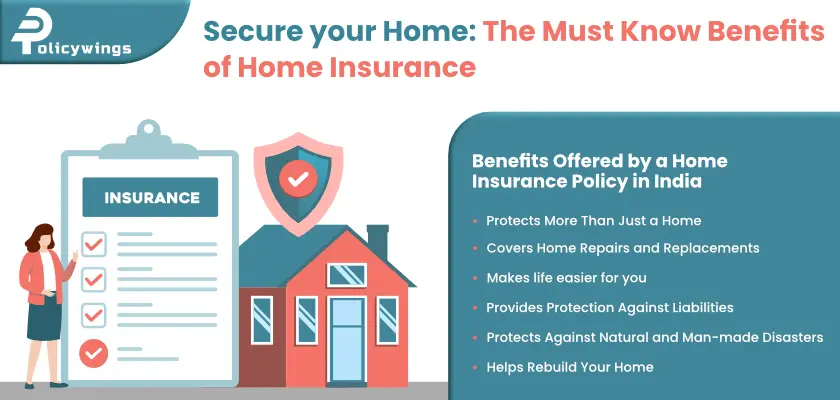
Benefits Offered by a Home Insurance Policy in India

Here are the reasons why you should buy home insurance:

1. Protects More Than Just a Home

Unlike popular belief, home insurance not only just protects your home but also every supplementary structure that comes along with your house like your garage, backyard, fences, and every other belonging in the home. 
But, home insurance does not protect your land. 

2. Covers Home Repairs and Replacements

One significant benefit of home insurance is that it also takes care of the repairs and replacements you make because of every damaged or stolen property in the home. 

3. Makes life easier for you

You will also be covered for temporary living expenses until your home has been renovated or replaced if your home becomes damaged or uninhabitable for some unfortunate reason.

4. Provides Protection Against Liabilities

Home insurance also pays for any type of liabilities caused inside or because of your property. For instance, there was a fire at your house and it also spread to your neighbors. The insurance will protect you and your house from any such legal problems. 

5. Protects Against Natural and Man-made Disasters

Home insurance also protects your home against the damages caused due to natural calamities like floods, earthquakes, or man-made disasters like thefts and riots. 

6. Helps Rebuild Your Home

Seeing the home getting destroyed that you worked so hard to build can be very disheartening. The more painful part is to rebuild it again. Having home insurance will help you financially while rebuilding your home. 

On top of all these benefits, you will get peace of mind for a lifetime. 

Because home insurance offers such a wide range of benefits, skipping on purchasing one will surely expose you to several financial risks associated with your home.

So, if you are planning to buy a house, don’t forget to get your home insurance coverage.

PolicyWings is an insurance brokerage site where you can compare several home insurance policies to choose the one that best suits you.

To learn more in detail about the home insurance plan than reach out to us and our consultant will answer all your question so that you get complete surety. 

By home insurance cover through PolicyWings for a tension free life.

FAQs

What is home insurance in india?

A home insurance cover in India offers protection against any loss or accidental damage to the home or the contents of the home like electrical appliances, fixtures, and many more personal belongings.

What are the benefits of taking home insurance?

The list of benefits that you will get after buying home insurance in India are:
Complete home protections
Coverage against home repairs and replacements
Protection against liabilities
Coverage against natural or man-made disasters…and many more.

What is covered under home insurance?

Home insurance typically covers damage to a home and its contents due to events like fire, theft, and natural disasters. As part of the policy, you are also covered for liability for injuries on the property and additional living expenses in case the home becomes uninhabitable.

Can you claim for lost jewellery on home insurance?

Yes, you can claim for lost jewelry on home insurance if it includes personal property coverage. However, coverage limits and conditions apply, and you may need additional endorsements or riders for high-value items.

Does home insurance cover wall cracks?

Home insurance usually doesn’t cover wall cracks caused by wear and tear or poor maintenance. However, it may cover cracks resulting from sudden, accidental events like storms, earthquakes, or water damage, depending on the policy specifics.


Share this article:

You may also like: Business Insurance

Related guides from our business insurance desk.

Why Your Business Needs Commercial Property Insurance?Commercial Property Insurance

Why Your Business Needs Commercial Property Insurance?

Introduction The best thing about running a business is making profits but it’s equally important to protect what you’ve built. You spend years setting up your workplace, what if it gets all damaged overnight by a fire accident or maybe an earthquake? It’s not even easy to think of such a situation. This is why you need commercial property insurance. Sadly, many businesses underestimate the importance of property insurance, because they keep thinking that nothing so bad will happen. But this is life. Risks are unpredictable. One incident and it may cost you lakhs or even crores. Only with the right coverage through commercial property insurance plans you can protect your hard-earned investment. We are here to help you understand why every business, regardless of size, must have commercial property insurance. What is Commercial Property Insurance? It’s a type of insurance that protects your valuable business property against damaging risks like fire, theft, natural disasters or anything that causes loss of property. Not just the building, it also covers the assets inside it like equipment, tools, machinery, furniture, raw materials, finished goods etc Let’s suppose a fire accident happens in your office and it damages your building and destroys your equipment. Now, commercial property insurance will cover the cost of repairs and replacements. Yes, the load will not fall on your pocket. Without insurance, all your savings will go into fixing your office or you might even have to take loans. Why is Property Insurance so Important for Businesses? It doesn’t matter if you own a small shop or a huge factory; it’s your business and your operations rely on it. Damage to the property directly disrupts your business and impacts your income. Property insurance is essential because: It protects all your physical assets in the workspace. It makes sure the business continues even after an accident. It provides the much-needed financial stability during tough times. It doesn’t let your working capital or savings be wiped out for repairs or replacements. In short, without property insurance, all operations will come to a halt after a single bad event. What Do Commercial Property Insurance Plans Cover? While all insurance providers offer different coverage, here’s what most commercial property insurance plans protect from: Buildings and Structures– Workspaces like corporate offices, large warehouses, showrooms and factories. Furniture and Fixtures– All your desks, chairs, shelves and other furniture that’s set up. Machinery and Equipment– Tools & equipment used for manufacturing, heavy machinery and even computers/laptops. Stock and Inventory– Raw materials and finished goods present in the facility and even the goods in transit. Loss of Rent/Income– In case your property becomes unusable due to the damage caused. Natural Disasters– Damaging disasters like heavy floods, earthquakes, storms, large cyclones etc. Man-Made Risks– If there’s fire, theft, riots, strikes or other intentional damage. This is why commercial property insurance plans are adaptable to the different industries it is being taken for. Benefits of Commercial Property Insurance These are the top reasons that convince you to get your property insured: Protection Against Financial Loss: If a disaster, whether natural or man-made, can cause huge financial damage. With insurance in place, there’s no need to pay for any repairs and replacements from your pocket. Business Continuity: When operations are disrupted, it can lead to loss of income. Thankfully, many policies cover the loss of income, thereby making sure that your cash flow isn’t completely stopped. Peace of Mind: The assurance that your property and assets are protected lets you focus on growth with a relaxed mind and you don’t stay worried about unexpected situations. Covers More Than Just Buildings: Remember that insurance isn’t limited to just the physical building. It also covers your finished and raw stock, machinery, furniture and sometimes even electronic data (add-on benefit). Improves Business Credibility: Insured businesses are preferred by banks, investors, and even clients because they seem more stable and reliable. If you have property insurance, it means you take your risks seriously. Who Needs Commercial Property Insurance? Honestly, any business that owns or rents physical space should consider getting it. They could be: Retail Stores & Showrooms– To protect their inventory and display stock. Warehouses– To secure all the goods and raw materials stored in the facility. Manufacturers– They need it to protect their machinery and production equipment. IT Companies– It covers all the office equipment like laptops, servers etc. Restaurants & Hotels– Insurance ensure the kitchens, furniture, interiors and related assets are secure. Not just these sectors, even small businesses like salons, coaching centers and workshops can go for commercial property insurance plans, because risks are there for businesses of all sizes. Common Risks Businesses Face Without Insurance Not having commercial property insurance means your business is exposed to some serious risks like: You have to pay for heavy repair or replacement costs from your own pocket. Customers may go to another business because of operational shutdowns. Risk of bankruptcy, especially if the damage is not easy to recover from. You might struggle with banks or investors due to a lack of credibility now. One accident, maybe due to fire, flood or a major robbery, can affect your years of effort if there’s no insurance. How to Choose the Right Commercial Property Insurance Plan There are a few things that you must keep in mind when comparing commercial property insurance plans: Assess Your Assets– Make a detailed and proper list of all the property, stock and equipment you want to secure. Understand What’s Included and What’s Not– Remember that policies may not cover all kinds of damages. Check Add-ons– You can opt for extra benefits like electronic equipment cover, goods in transit or natural disaster extensions for stronger coverage. Compare Premiums vs. Coverage– Buying the cheapest is not the solution. Focus on value for money. Reassess Regularly– Do update your coverage as your business grows so you’re not underinsured. For example, a sudden electrical fire happens in a small textile factory that damages machines worth ₹37 lakh.

Written bySagar NarangPublished onNovember 17, 2025
Business Interruption Insurance Can Save Your Company TodayBusiness Insurance

Business Interruption Insurance Can Save Your Company Today

Introduction A solid risk management plan has to have both business interruption and loss of income insurance which gives a safety net in case of unexpected situations. Whether it’s by supply chain disruptions, legal closures, cyberattacks or natural hazards/disasters this coverage protects businesses from revenue loss and also keeps all things stable while they are recovering. Understanding Business Interruption Insurance When operations are halted because of covered events, business interruption insurance reimburses a company for lost revenue and additional costs. Standalone policies concentrate exclusively on the financial effects of operational stoppages even though they are frequently an addition to property insurance. Usually covered are: Replacement of Gross Income: Makes up for money lost during the disruption. Payroll utilities and rent are examples of continuous commitments that are supported by fixed cost coverage. Extra Expense Coverage: Provides coverage for extra expenses (such as temporary relocation and emergency services) required to resume operations more quickly. This policy is income dependent which means that the indemnity is correlated with actual business losses and necessary expenses in contrast to other insurance types that pay fixed benefits. Legal and Regulatory Context in India Regulatory frameworks highlight the significance of business interruption insurance in industries such as banking healthcare and critical infrastructure despite the fact that it is not required in India. The terms and issuance of such policies are governed by the Insurance Act of 1938 and IRDAI guidelines which guarantee coverage standards and claims procedures. Furthermore the principles of indemnity and loss mitigation are applicable under Sections 73 and 74 of the Indian Contract Act 1872. Policyholders are required to minimise losses properly document claims and refrain from taking risks following a covered event. Why Companies Often Underestimate Its Importance When business stops, organisations usually concentrate on protecting their physical assets while ignoring the hidden financial strain. Long periods of downtime however can quickly deplete reserves and result in financial difficulties, supplier default or even insolvency. This gap is filled by business interruption coverage which aids in preserving liquidity during crucial times. Real World Lessons That Emphasize Its Value Natural Disasters: Businesses without this coverage regularly find themselves unable to cover operating costs in areas hit by earthquakes or floods which can result in bankruptcy even if physical damage is repaired. Cyber and Systems Failures: Operations/functions can be rapidly shut down by a ransomware attack or an extended IT outage. Such occurrences are usually not covered by standard property policies which emphasises the necessity of specific interruption coverage catered to digital risks. Regulatory Shutdowns: Government mandated closures like lockdowns for health emergencies or halts for environmental compliance can severely reduce revenue. Companies with interruption insurance are better equipped to withstand mandated outages. Two startling facts emerge from these situations: insurance terms need to be exactly in line with business realities and not having coverage is not just dangerous it could be disastrous. Policy Design: Legal Considerations and Best Practices Clearly Define the Covered Events Cyberattacks, pandemic closures and civil unrest may not be covered by standard policies. Indian companies are required to evaluate their risks and negotiate extensions particularly with regard to “non-damage business interruption” which refers to risks that do not entail physical harm. Establish Sufficient Coverage Duration Usually indemnity periods last between 30 and 90 days but more extensive coverage may be needed for complex recovery operations like facility reconstruction or data restoration. Businesses should negotiate adequate “extended indemnity periods” in accordance with industry standards and risk assessments. Make Sure Your Revenue Estimate Is Correct In order to determine lost income insurers frequently need historical financial data. To substantiate claims and prevent disagreements, accurate documentation is crucial including daily sales records, supplier contracts and cost structures. Awareness of Exclusion Losses brought on by underinsurance government action or postponed maintenance may be excluded by many policies. To prevent rejection legal teams should carefully review the terms, offer advice on any coverage gaps and make sure that claims are started on time. Restore and Reduce Policyholders are required to take reasonable measures to quickly resume operations such as using alternate locations rerouting supply chains or implementing temporary workarounds. Under Section 73 of the Indian Contract Act courts have the authority to reject claims in cases where the loss could have been reasonably mitigated. The Financial Significance of Business Interruption Coverage Cash Flow Stabilisation: Even during extended pauses the indemnity guarantees that operational commitments such as rent loan repayments and salaries are fulfilled. Stakeholder Assurance: deals with the coverage of showing resilience promotes trust in lenders, suppliers, customers and investors. Competitive Advantage After a Crisis: Companies that can bounce back fast tend to gain market share, recover more quickly and come out stronger than their peers without insurance. Sector Specific Considerations Manufacturing and exporters should evaluate supply chain vulnerabilities and make sure that unreported losses aren’t caused by delayed shipments or damaged infrastructure. Retail and hospitality may experience abrupt declines in foot traffic or be forced to close. Continuity is ensured by coverage specific to business or physical interruption. IT and Digital Services: Data breach and digital downtime coverage are becoming more and more essential as cyber threats increase. Global Precedent: Singapore’s Circuit Breaker Case Businesses with “non-damage business interruption” policies were able to successfully claim losses even in the absence of physical damage during Singapore’s strict COVID-19 “circuit breaker” restrictions while many others with inadequate wording were not covered. This demonstrates how the wording of policies can make or break indemnity outcomes in disruptions caused by the government. Conclusion Even though they are frequently disregarded, business interruption and loss of income insurance can literally mean the difference between surviving and failing when operations are interrupted. This coverage serves as a strategic shield preserving long term resilience preserving solvency and safeguarding reputation. Companies can turn an insurance clause into a lifeline by carefully matching the policy wording with your business risks, making sure that the right paperwork is in place, negotiating suitable indemnity periods and proactively managing loss.

Written bySagar NarangPublished onDecember 9, 2025

Explore: Claims & Support

Broaden your view with a quick read on claims & support.

Car Insurance Claim Process in India: Step-by-Step GuideClaim

Car Insurance Claim Process in India: Step-by-Step Guide

Whether it’s a little scratch or a big accident, a car insurance claim can save time, money and a lot of unnecessary stress. Sadly, filing a car insurance claim seems like a complicated task to a lot of people. They tend to get all blank when the situation arises. When in reality, it’s just a simple process. Once you know what to do and when, you will have your vehicle back on the road faster. Here, we will discuss how to get the most benefit of your insurance and what a well-handled claim actually looks like. Step 1: First, Ensure Safety Before you get straight to thinking about insurance, just make sure that everyone is safe around you. If possible, move the car to a safe spot Switch on hazard lights If anyone is injured, call for medical help There is nothing bigger than personal safety. The ‘claim’ part should come later. Step 2: Immediately Inform the Insurance Company Once you have the situation under control, it’s time to inform your insurer. Most insurers let you contact them through a customer care helpline, mobile app or website, writing an email or simply by visiting the branch. The earlier you inform, the better your insurer can guide you and speed up the process. Step 3: File an FIR In certain situations, you need to file an FIR. It could be after: The vehicle gets stolen There has been a major accident involving injury or death There is physical or property damage to third party If there are only minor damages, insurance providers usually don’t ask for an FIR. Still, you must always confirm with your provider. Step 4: Document the Damage A claim settlement can become much smoother if you have proper documentation in place. Your insurer may ask you to: Take clear photos or videos of the damaged vehicle Provide the date, time and location details of the incident Share basic details of what exactly happened This step is where you exchange proofs that help the insurer assess the claim accurately. Step 5: Vehicle Inspection by Surveyor After you have informed your insurer about the claim, the insurance company then appoints a surveyor who will come to inspect the vehicle. Depending on the insurer and severity of the damage, inspection may either happen physically at the garage or can even be done digitally through photos/video calls. A reliable motor insurance provider will make sure that inspections are timely done because delays can slow the entire claim process. Step 6: Repair at Network Garage or Preferred Garage You now have two options for the repair work: Cashless Claim (Network Garage): You can take your car to an authorised garage to fix it. Your Insurer settles the bill directly with the garage and you only have to pay for deductibles and non-covered items. Reimbursement Claim: You make an upfront payment for the repair bill and submit invoices and documents to the insurer. For this, you will be reimbursed later. This step becomes much easier when your policy is backed by an extensive network of garages. Step 7: Claim Settlement Once all repairs are done and documents are verified, you can relax. The insurer will settle the claim. The final amount depends on the coverage amount of the policy, deductibles and depreciation. If you have bumper to bumper insurance, depreciation is not a stress. An honest insurer will clearly explain if there will be any deductions. This really builds trust in the process. Step 8: Delivery of Vehicle After the settlement is done, the garage releases your vehicle and you can thoroughly inspect the repairs before taking your vehicle home. This is the stage when your claim is considered closed. How Add-Ons Affect the Claim Experience Add-ons are often very helpful and make your policy stronger. They can really make the claim process smoother for you. Let’s take examples: Zero depreciation (bumper to bumper insurance): Reduces depreciation deduction on parts Roadside assistance: Helps a lot during claims related to breakdowns Similarly, there are other add-ons. While they lightly increase premiums, they also simplify the claim experience. Common Reasons Why Claims Get Delayed or Rejected Here is the most important part. Some people complain that their claim wasn’t settled or that there have been issues. But this is because they made these mistakes: They were late for claim intimation Their documents were incorrect or incomplete Driving under the influence (eg. Alcohol) Policy had expired at the time of the incident A policy alone won’t solve things for you. While filing a claim, make sure you follow the right process whether you have the cheapest insurance for car or an expensive one. Why Claim Support Matters More Than Premium Premium is surely an important part of buying car insurance. However, the real test of a policy is during a claim. When claim support is strong, it means: Claim intimation is very easy Inspections are done faster Clear communication at each step Settlements are done on time Conclusion In India, the car insurance claim process is pretty structured. But your experience will largely depend on how informed you are about the process and how supportive your insurance provider. Keep in mind all the discussed steps because they will put you in control. Whenever something unexpected happens, you know what to do next. At the end, good car insurance not only protects your vehicle but also supports you in need.

Written bySagar NarangPublished onJanuary 23, 2026